Why Does the Logo Design Process Matter Before You Pick a Single Color?
Most people think of logo design as being a flash of inspiration. A designer is looking at a blank screen, a clever thing shows up and the job is done. Actually, great logos are the result of a series of decisions that can be repeated, and missing one of them results in a logo that either looks generic or fails to look good.
By knowing how the logo design process works, you can ask better questions, provide clear feedback and identify a logo that isn’t just a quick template, but a thoughtful brand mark. It also saves money, as there are no more surprises, resulting in less rounds of rework. This guide covers each step from the first conversation to the files you will end up receiving, so that you can know what to expect at each step.
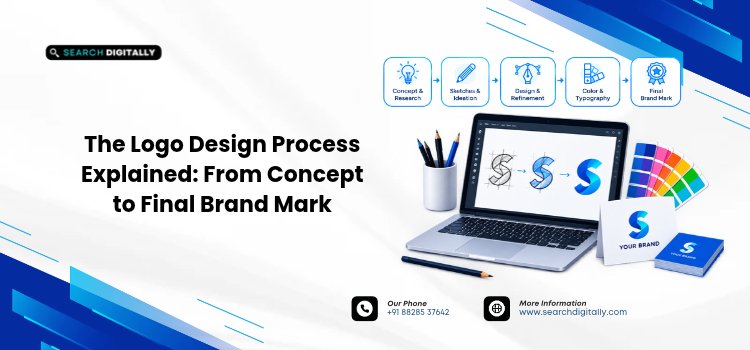
Step 1: Discovery and the Logo Design Brief
All powerful logos begin with questions and not sketches. The designer should find out what your business is, who it’s for and how you want your customers to feel when they see it. This is the logo design brief, the document that will keep all parties in sync throughout the remainder of the project.
A useful brief usually covers:
- Your business, products, and long-term goals
- Your ideal customers and where they will meet your brand
- Personality terms like trustworthy, playful or premium
- Where the logo is going, such as app icons to sign boards
- Styles or competitors you like, and ones you want to avoid
Keep in mind that a logo is one piece of a wider system. If you are still shaping your positioning, this guide to building a brand identity that lasts is worth reading first.
Step 2: Research and Competitor Review
Designers research the market they are going into, prior to creating anything. They consider what colors and symbols are used more than others in your competitive field and how you can make yourself stand out. A steel supplier, a bakery, and a fintech startup all carry different visual expectations, and ignoring that context leads to marks that feel out of place.
Many designers will also create a mood board here. It’s a simple assembly of fonts, materials, and colors to share a common visual vocabulary to respond to before ideas start.
Step 3: Sketching and Logo Concept Development
This is where ideas turn visible. Most designers start on paper as it is fast and easy to work with and they get many rough sketches that go in different directions. The Logo concept development is intentionally unrefined at this point. The goal is range, not polish.
Designers usually explore a few approaches:
- Wordmark: the business name printed in a special or carefully selected typeface.
- Symbol: a standalone shape that represents the brand
- Combination mark: a symbol paired with a wordmark
- Monogram: initials formed into a small lettering or symbol.
From the pile of sketches, the strongest two or three ideas move forward. A good test is simple: does the idea still read clearly when it is tiny and in black and white?
Step 4: Digital Refinement of Type, Color, and Shape
Selected sketches are constructed on screen, typically in a vector format, allowing them to be made as large as a favicon or billboard without sacrificing sharpness. Here the details matter. The gap between letters, the contour of a stroke and the ratio between symbol and text all influence a professional feel to the completed mark.
Then comes color and it should be used to serve the brand and not to decorate. A designer looks at palettes against the brief, verifies contrast for readability and verifies that the logo works in one colour. Typography receives the same attention, as a letterhead has a personality of its own as the symbol itself.
Step 5: Presenting Concepts and Handling Logo Design Revisions
Now that the refined concepts are presented, ideally with mockups on a website header, a business card and a social profile. The actual use of the logo in real-world contexts is a lot easier to assess than on a blank piece of paper.
Good feedback is specific and related to the brief. “Don’t like it” leaves a designer with not much to go on; “the symbol feels too aggressive for a family-based brand” is a definite red flag. Most projects have a limited amount of logo design revisions and collect input from all decision makers first before sending out a combined list.
Working with an outside team? This guide on how to choose the best logo design company explains what to check before you sign.
Step 6: Delivering the Final Logo Files and Brand Mark
Once you’ve approved a direction, the designer will solidify the brand mark and create the final logo files that you will use for years to come. Adobe’s Illustrator tutorial states that logos are best when used as vector images; therefore, you’ll want to be given vector source files as well as the traditional web formats.
| File format | Best used for |
| AI or EPS | Master editing and professional printing |
| SVG | Websites and scalable digital use |
| PNG | Transparent backgrounds on web and social |
| Print-ready sharing with vendors | |
| JPG | Quick previews and documents |
Request variations in design (e.g. horizontal, stacked, icon-only, light and dark versions) and a quick reference guide on spacing and colour codes.
Conclusion
The logo design process consists of six clear steps: discovery and the logo design brief, research, sketching and developing the logo concept, digital refinement, structured revisions for the logo, and delivering the final logo files. Every stage brings the choices down to a final option: a brand mark that is clear, flexible and ready to represent your business. By knowing the sequence, you can provide more focused feedback, prevent expensive rework, and end up with a logo that lasts.
FAQs
Q1. How long does the logo design process take for a small business?
Small projects typically take 2-4 weeks, depending on the speed of giving feedback and approvals. A well-drafted brief at the beginning will help to keep things flowing.
Q2. How many logo concepts should a designer present?
A typical method is to present 2-3 well developed concepts. It allows you to have a choice without being overwhelmed and it maintains the quality over quantity.
Q3. What logo file formats should I ask for from my designer?
Request vector files (AI, EPS or SVG), a PNG with a transparent background, a print ready PDF and a JPG. It’s also helpful to have a light and dark version of the logo.
Talk to the Search Digitally team.
Contact page: https://searchdigitally.com/contact.php Email: support@searchdigitally.com