
What is Enterprise Website Development, and Why Small and Medium Businesses Should Care?
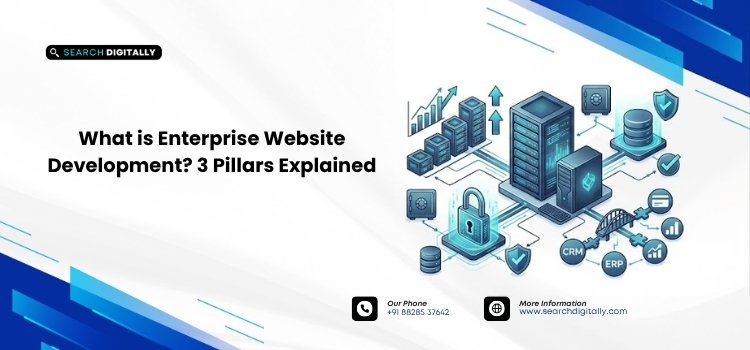
What is Enterprise Website Development? In simple terms, it is the process of creating a website that’s expected to do more than just display a digital brochure: it is designed to handle heavy traffic, integrate with internal systems, and protect sensitive data. That change typically occurs subtly for a small to medium-sized business that is expanding. One day, the website becomes just a few pages; the next, it has to communicate with a CRM, process payments, support multiple regions, and remain online during a product launch without breaking a sweat. At this juncture, basic website creation is no longer sufficient; enterprise-level thinking is essential. This guide will show you the key differences between an enterprise build and a regular build, and the importance of the 3 pillars: scalability, security, and integration as more important than any single design trend.
Key Takeaways
- Enterprise Website Development is engineered to grow, support complex systems and deal with greater stakes; not simply be pretty.
- Scalability determines whether your site survives a traffic spike or a new product line without a rebuild.
- Security protects customer data and business reputation, and it needs to be planned in from day one.
- Integration connects your website to the tools your business already uses, such as CRMs, ERPs, and payment gateways.
- A modular development approach and genuine Performance optimization expertise are what make all three of the above realistic to maintain over the long term.
What Separates Enterprise Website Development From a Standard Business Site?
Typical small-business websites are created to serve a single purpose: to provide information and turn visitors into leads. Enterprise Website Development starts from a different assumption. It assumes the site will grow, that more people and systems will depend on it, and that failure carries a real cost.
That changes almost every decision along the way. Rather than a single template and a few pages, multiple departments can publish multiple content types, use multiple third-party systems to exchange data, and see traffic increase dramatically during a sale, press mention, or seasonal period. It’s less about the homepage’s look and more about whether the platform below can keep up as the business does well.
Scalability: Building for the Traffic and Content You Do Not Have Yet
Scalability is typically the first thing that most business owners don’t consider, and it is hard to see until it goes wrong. If the website was not designed to scale, it can slow to a snail’s pace after it reaches 5,000 visitors per day.
The key to real scalability is the deliberate choices that were made at the beginning:
- Hosting infrastructure that can scale horizontally, meaning you can add more servers when demand requires it, but not have their use limited by a single server.
- A content structure that makes thousands of pages manageable and easy to manage.
- Caching and content delivery strategies that keep load times low even as traffic grows
- Database design that doesn’t get hopelessly complicated when there are thousands, or even tens of thousands, of records.
That’s where real Performance optimization expertise comes into play. It is not a one-time speed test before launch; it is an ongoing discipline of monitoring load times, optimizing images and scripts, and catching bottlenecks before customers notice them. A site that stays fast under pressure protects both user experience and search rankings, since page speed remains a factor search engines weigh directly.
Security: Protecting Data, Trust, and Uptime
Security on an enterprise site is not something that can be built on after launching; it needs to be built in from the first line of code. The stakes only increase; more integrations, more customer data, and more sightlines make them a more desirable target.
A serious enterprise security posture typically covers:
- Encrypted connections and secure handling of customer and payment data
- Role-based access control so employees only see what their job requires
- Regular vulnerability testing and patching, rather than a set-and-forget approach
- Protection against common attack patterns like injection and cross-site scripting, the kind of risks the OWASP Top 10 has documented and tracked for over two decades
For a small or medium-sized business, a security incident is not just a technical headache. It is a trust issue with customers and partners that can take much longer to mend than the breach itself did to occur.
Integration: Making the Website Part of the Business, Not a Silo
The third pillar, Integration, is what turns a website from a static marketing tool into an operational asset. Most growing companies already use a stack of tools: a CRM for sales, an ERP for inventory or operations, an email platform for marketing, and a payment platform for transactions. An enterprise website is built to plug into that stack rather than sit apart from it.
A successful integration results in a lead captured on the website being added directly to the CRM, inventory updates in the ERP being reflected immediately on the product pages, and a customer’s order history being visible across every channel they use. Done poorly, it means staff manually copying data between systems, which is slow, error-prone, and expensive to maintain as the business grows.
This is also where a modular development approach pays off. Building the site as a set of independent, well-defined components, rather than a single tightly coupled block of code, makes it far easier to add a new integration, swap out a payment provider, or update a single feature without risking the rest of the platform.
Scalability vs Security vs Integration: How They Compare?
| Pillar | What It Solves | What Happens Without It |
| Scalability | Handles growing traffic, content, and users | Site slows down or crashes during growth spikes |
| Security | Protects data and system access | Breaches, downtime, and loss of customer trust |
| Integration | Connects the site to business systems | Manual data entry, disconnected tools, wasted staff time |
How Enterprise UX Design Ties the Three Pillars Together?
Scalability, security, and integration are largely invisible to the end user, which is exactly why Enterprise UX Design matters so much. A visitor never sees the caching layer or the access control rules at work behind the scenes, but they certainly feel the effect of a fast site with predictable behavior, providing the right information to the first-time browser as well as the enterprise buyer exploring a complex catalogue.
Good enterprise UX design takes into consideration a variety of users, including casual users, logged-in customers, and internal users managing content, and organizes navigation, search, and page hierarchy accordingly. That structure is only sustainable at scale if the technical pillars underneath, scalability, security, and integration, are already solid.
Conclusion
Enterprise Website Development is about creating a website for a business you are developing, not just one that already exists. Scalability keeps the site fast and stable as traffic and content grow. Security protects customer data and the trust that comes with it. Integration is the process of linking the website with existing systems a business relies on. None of these pillars works in isolation, and a modular development approach, paired with real performance optimization expertise, is usually what makes them sustainable over time. For a small or medium-sized business planning its next website or rebuild, thinking in these terms early tends to save far more time and money than retrofitting them later.
FAQs
Q1. Do small businesses need enterprise website development?
Not always, but once traffic grows, tools need to connect, or customer data is involved, the same scalability and security principles apply.
Q2. What’s the difference between enterprise and standard website development?
Enterprise builds a plan for growth, integrations, and security from the start; standard sites are usually simpler and built for a single purpose.
Q3. Is a modular development approach worth it for a smaller website?
Yes, it makes future updates and integrations easier, even if you’re not at enterprise scale yet.
Ready to Plan Your Enterprise Website the Right Way?
If your business is outgrowing its current website, whether that shows up as slow load times, disconnected tools, or growing security concerns, the right move is to plan the rebuild around scalability, security, and integration from the start. For a closer look at what the full build process involves, this breakdown of how long it takes to build a website and this guide on choosing the right website development company are good next steps before you commit to a partner or a timeline.