
Why SaaS and Developer Docs Are a Different Case for llms.txt?
Most conversations about what llms.txt actually is treat every website the same way, as if a marketing blog and a developer documentation portal have identical needs. They don’t. If you are running llms.txt for SaaS product, particularly one with technical documentation, API reference, and SDK guides, the file is addressing a problem that does not even really occur on a standard brochure website.
Developer docs are read by two very different audiences today: humans searching Google, and AI coding assistants pulling context to answer a developer’s question or write code on their behalf. That second audience didn’t really exist a few years ago. Now it’s a valuable piece of how technical content is being consumed, and it alters the definition of “discoverability” for a SaaS company. This is the space that llms.txt was designed to fill, and it’s what makes this file seem more relevant on a regular business site than it does here.
What llms.txt Developer Documentation Actually Solves
A documentation site is usually a maze. Versioned pages, nested API references, change logs, migration guides, even deprecated endpoints still in the index. A human developer can use search and intuition to get around this. An AI agent that seeks context to answer a question cannot have this intuition without a clear map to follow.
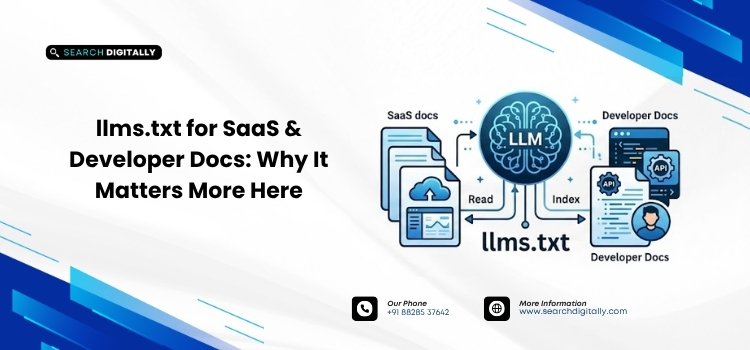
This is the actual task of llms.txt for developer docs. It’s a plain-text file at the root of your site that lists your most important pages in order of relevance, with short one-line descriptions attached, and setting one up is a fairly quick technical task once you know which pages to prioritize. Rather than an AI tool randomly selecting a handful of your 40 API pages, you’re giving it a curated list of the important ones.
For a SaaS company, this matters in a few concrete ways:
- Your docs likely have multiple versions live at once, and an outdated v1 endpoint page ranking above your current v3 page can send an AI agent the wrong instructions entirely.
- Technical content changes fast. New releases, deprecated features, and breaking changes need to be reflected quickly, and llms.txt gives you a lightweight way to point AI tools at the current source of truth.
- Documentation is often the first place a developer evaluates whether your product is worth integrating. If an AI coding assistant misreads your docs, that developer’s first impression of your API is wrong before they’ve even opened your dashboard.
AI Crawlability SaaS Companies Actually Need to Think About
AI crawlability for SaaS isn’t simply about findability. It’s about being findable correctly. A marketing site can withstand a little ambiguity about what AI tools interpret from its pages. A documentation site cannot, because if the AI gives the wrong answer, it’s a broken piece of code, a failed API call, or a developer abandoning your product.
This is also where the current data gets interesting. Independent research this year showed that few (very few) of the published llms.txt files are actually receiving any traffic from AI systems at all, and a large-scale analysis of over a hundred thousand domains was conducted to this end. The bots which appeared regularly were not AI-based search crawlers. They were coding agents, the very audience documentation for developers is attempting to reach. That’s a very valuable signal for a SaaS business: llms.txt might not have much of an impact on a typical content website, but it’s speaking to the one audience that is most likely to use it for a docs portal.
llms.txt SEO vs. llms.txt for AI Agents
It’s worth being clear about something a lot of teams still get wrong. llms.txt SEO benefits, in the traditional Google ranking sense, are essentially nonexistent, and the data on this is worth reviewing before you set expectations internally. The major search engines have explicitly stated that the presence of the file is not necessary for ranking and it does not have to show up in AI search experiences. If you are publishing llms.txt because you want it to improve your organic search rankings, that’s the wrong goal to have set with your team.
Where it does have a role is generative engine optimization for SaaS products specifically tied to developer tooling. It’s not the “classic” SEO. It’s ensuring that when an AI coding assistant is editing a developer’s code editor, and needs to use your API, it’s using the correct, up-to-date page rather than the old or incorrect one.
Should Every SaaS Website Publish llms.txt for SaaS Websites?
Not everywhere, but the numbers can be significantly different depending on the type of SaaS business you have.
| Site Type | llms.txt Priority |
| API-first or developer tooling SaaS | High, agents actively read technical docs |
| Standard business SaaS marketing site | Low, minimal AI agent traffic expected |
| SaaS with public changelog or versioned docs | Medium to high, helps avoid outdated references |
If your product depends on developers integrating your API, then this is a low-effort, low-risk addition that’s worth it once you understand how it differs from your existing robots.txt and sitemap.xml files and where it adds value on top of them. If your site is a general SaaS marketing site and you don’t have a technical documentation layer, you’re better off spending your time elsewhere.
Conclusion
The llms.txt for SaaS and developer docs is not for chasing rankings in search engines since that is not what it does. It’s about providing your technical content, which is clean and up-to-date, to your coding agents, so that developers can refer to your endpoint, your version, and your guide. For companies where documentation quality directly affects product adoption, that’s a real and growing use case, even while the broader hype around llms.txt for general SEO has cooled considerably.
FAQs
Q1. Does llms.txt help SaaS companies rank higher on Google?
No. llms.txt is not a Google ranking factor and won’t directly improve your search rankings. It’s most useful when directing AI agents and coding assistants to relevant, up-to-date documentation pages.
Q2. Is llms.txt only useful for developer documentation sites?
It’s most useful for SaaS products with technical documentation, API references, or versioned content, as these are the types of content that are most actively read by the audience today. The general marketing sites don’t get nearly as much benefit.
Q3. How is llms.txt different from a sitemap for a SaaS docs site?
A sitemap is a prioritized short list of pages that you’ve handpicked to be included in the index, especially for AI tools, to prioritize your most important or current pages instead of everything on your site.
Not sure whether llms.txt is worth prioritizing for your SaaS platform or developer docs? Contact our digital growth team at support@searchdigitally.com.