
Why AI Search Is Rewriting the Rules of Visibility
Search behavior has changed more rapidly in the past two years than in the preceding ten. People increasingly ask a question with ChatGPT, Perplexity, Gemini, or Google’s AI Overviews to get an answer, without necessarily linking to a website. That change has led to Generative Engine Optimization, or GEO. The art of organizing a business’s content, brand indicators, and technical configuration in a way that will enable AI systems to discover, trust, and cite a business when producing an answer. In addition to GEO, there’s also a small extra technical file named llms.txt that’s caused a lot of noise, and agencies, plugins, and website builders are all scrambling to sell it. This guide clearly divides the two and explains the purpose of the llms.txt file, its limitations, and what this means for a working GEO strategy in 2026.
What Is Generative Engine Optimization (GEO)?
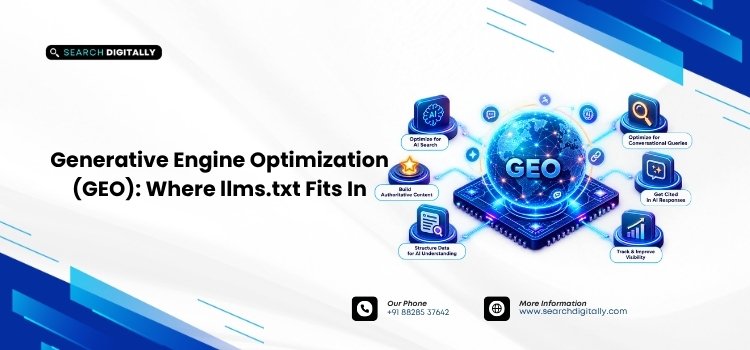
Generative Engine Optimization (GEO) involves optimizing digital content and technical elements to ensure that AI-powered tools like ChatGPT, Perplexity, Google AI Overviews, and Claude reference, quote, or suggest a brand when asked a question. The term comes from a highly cited academic article that coined and quantified the field, examining which content strategies increase a webpage’s likelihood of being cited by generative systems.
Unlike regular SEO, which fights for one of the 10 blue links, GEO is the one that fights for one of the limited number of sources that an AI engine pulls into its answer, typically 2-7 sources per answer. That difference changes the definition of “optimization.” It’s possible for a page to show up on page one on Google and not be cited by an AI system because the two systems are assessing a page for different purposes: SEO is looking at the page for signals of relevance and authority (on a results page), and GEO is asking if the specific paragraph is quotable, well-sourced, and easy to extract.
Studies on what actually leads to citations show that content with a clearly referenced statistic, an expert quote, or a direct citation is measurably more likely to be found by generative engines, with no measurable boost for keyword stuffing or artificially simplified writing. In practice, this is the same behaviour that endears trustworthy content to a human reader: using specifics for the reader, providing clear source information, and structuring the content so a specific answer can be lifted out of context and still make sense.
llms.txt Explained: The File Everyone’s Talking About
The llms.txt file is a simple text file that lists the most important pages on a website, with concise, one-line descriptions so an AI system can get an overview of the site without navigating the full HTML pages. It was suggested in September 2024, and the standard template includes an H1 with the site or brand name, a brief summary, and links by section.
Also, a companion format, llms-full.txt, has appeared for sites that want to share page content instead of the index. Large language models work well when ingesting technical information directly, such as developer documentation or API platforms, without crawling page by page.
It is important to be clear about what an llms.txt file isn’t. It has no backing from a standards organization such as the W3C or IETF, no enforcement mechanism, and each AI provider can choose to use it, ignore it, or support it partially. This differs significantly from robots.txt, which crawlers are expected to follow, and from a typical XML sitemap, which search engines have supported for 20 years.
Where the llms.txt File Fits Into a GEO Strategy?
This is the part most explanations skip. GEO is a broad term that includes content quality, structured data, brand mentions on the web, and technical crawlability. The llms.txt is one of the many optional technical artifacts in that bigger picture, and it’s not a replacement for it.
A short comparison makes the scope difference clearer:
| Generative Engine Optimization (GEO) | llms.txt file | |
| Scope | Full content, structure, and brand strategy for AI visibility | A single Markdown file listing key pages |
| Goal | Get cited, quoted, or recommended in AI-generated answers | Give AI systems a lightweight map of a site |
| Effort | Ongoing: content, schema, authority signals, freshness | One-time setup, periodic review |
| Confirmed impact | Multiple tactics show a measurable lift in citation rates | No major AI engine has confirmed using it for citations |
An llms.txt file doesn’t automatically make a site GEO-optimized. The content itself matters more for citations: pages with a clear structure, content supported by research and data, FAQ pages that address how people ask questions, and schema markup that helps machines understand a page’s intent. If your team is considering FAQ schema as a part of this plan, you may want to read about the importance of FAQ schema for SEO and AI search before allocating efforts.
Does the llms.txt File Actually Move the Needle?
Adoption data from 2026 tells a mixed story. The study of approximately 300,000 domains showed that approximately 10% of them have an llms.txt file, and larger, more popular websites are using it a bit less than mid-traffic sites, contradicting the notion that larger brands are pioneering the use of the file. Server-log research has also found that most llms.txt files go untouched: One prominent study reported that few received any crawler requests, and that removing the llms.txt factor from citation-prediction models didn’t affect accuracy.
Major AI providers have been fairly candid about this. Guidance along the lines of using robots.txt to control crawler access has been reported, and Google voices have described llms.txt as more of a “convenience” than a ranking signal. The most obvious current use case isn’t consumer or B2B marketing sites; it’s developer documentation, SaaS platforms, and tools explicitly designed to be read by AI coding agents like Claude Code, Cursor, and GitHub Copilot, which we explore further in how AI coding agents use llms.txt. If your site will produce technical documentation, it’s also worth asking when llms-full.txt is more appropriate than the standard file, and what typically goes wrong when teams implement llms.txt without planning.
None of this means the file is worthless. It’s inexpensive to create, it does no harm, and it may become more consequential as adoption among AI providers matures. It should NOT be seen as a quick way to skip the harder work of Generative Engine Optimization.
How to Prioritize GEO and llms.txt Together
- Start with content structure. Use headings, concise answers at the top of each piece of content and FAQ blocks that are actually written in the way people ask questions.
- Back claims with sources. Before any technical file, a cited statistic or specific reference helps increase AI visibility.
- Add structured data. Schema markup helps traditional search engines and generative engines understand what a page is actually saying.
- Treat llms.txt as a low-cost addition, not a strategy. If your site has a lot of documentation or is geared toward developers, ship it, but don’t expect citation rates to take off on their own for a typical business site.
- Review and update regularly. A cornerstone page or content in an llms.txt file will not help with either SEO or GEO.
Conclusion
Generative Engine Optimization is the broader term for getting to be a part of the AI-generated answers, which is based on sourced, well-structured, and actually useful content. A small, easy-to-ship technical convention, the llms.txt file provides a cleaner map of a site that’s most valuable on documentation and developer-oriented platforms, and remains unconfirmed as a ranking and citation factor with most AI engines. The most common error teams make in 2026 is equating the two: Owning an llms.txt file is good, but it will not replace the content quality, sourcing, and structure GEO is built on.
FAQs
Q1. Do I need both an llms.txt file and a GEO strategy?
An llms.txt file is optional and works best as a small addition, not a replacement, for a genuine GEO strategy built around content quality, sourcing, and structured data.
Q2. Is llms.txt the same as robots.txt or a sitemap?
No. robots.txt controls what crawlers may access, a sitemap lists every URL for indexing, and the llms.txt file is a curated, human-readable summary of a site’s best content meant for AI systems, not a crawling directive.
Q3. Does having an llms.txt file guarantee my content gets cited by ChatGPT or Perplexity?
No. As of 2026, no major AI engine has confirmed that it uses llms.txt as a citation factor. Getting cited depends far more on well-sourced, clearly structured content than on this file.
If you’re trying to figure out where your site actually stands in AI search, and whether an llms.txt file is worth your team’s time, Search Digitally can help you build a Generative Engine Optimization plan around what actually earns citations, not just what’s trending. Contact us to get a clear, honest assessment of your AI search visibility.