
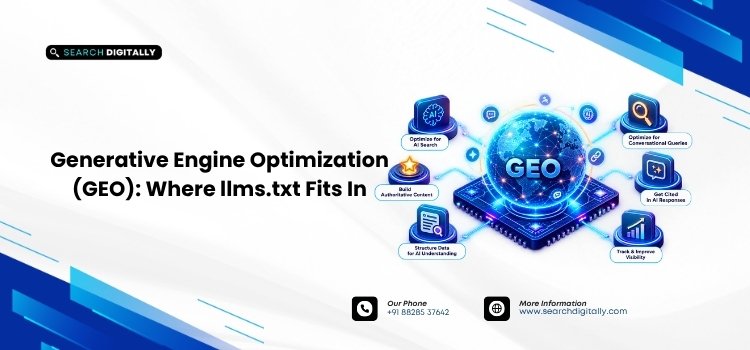
Generative Engine Optimization vs llms.txt: The Short Answer
Generative engine optimization (GEO) is the work of making your content easy for AI tools like ChatGPT, Perplexity, Gemini and Claude to find, trust and cite. The llms.txt file is one small, optional piece of that work, and the evidence so far says it does not earn citations on its own.
It still deserves a clear explanation, because llms.txt has attracted a lot of noise. Agencies, plugins and website builders are all selling it as a shortcut to AI visibility. This guide separates the two, looks at what the data actually shows, and explains what to prioritize in 2026.
Key takeaways
- GEO is the full job: sourced, well-structured content that an AI engine can quote. llms.txt is a single Markdown file that lists your key pages.
- The largest study to date, covering about 300,000 domains, found no link between having llms.txt and being cited in AI answers.
- Google’s John Mueller has compared llms.txt to the keywords meta tag, and no major AI provider has publicly confirmed that it uses the file to choose citations.
- The file is cheap and harmless, and it makes the most sense for documentation and developer sites.
- Put your effort first into content structure, cited statistics and schema markup.
What Is Generative Engine Optimization (GEO)?
Generative engine optimization is the practice of shaping your content so that AI answer engines reference, quote or recommend your brand. The term comes from a 2023 research paper, “GEO: Generative Engine Optimization”, written by researchers from Princeton, Georgia Tech, the Allen Institute for AI and IIT Delhi and accepted at KDD 2024.
The authors tested tactics such as adding statistics, expert quotes and source citations to a page. They reported visibility gains of up to 40% in generative engine responses, depending on the domain and the tactic.
That is a different game from ranking in a list of ten blue links. A page can sit on page one of Google and never be cited by an AI tool, because the engine is asking whether one specific passage is quotable, well sourced and easy to lift out of context.
What llms.txt Is (and Isn’t)
llms.txt is a plain Markdown file at the root of your site. It lists your most important pages with a short description of each, so an AI system can understand the site without wading through full HTML pages. Jeremy Howard of Answer.AI proposed it in September 2024, and our guide to what llms.txt is and how the format works covers the details.
A companion file, llms-full.txt, includes the full text of key pages instead of just links. It suits large documentation sets, and this explainer on when you need llms-full.txt shows how to decide.
What it isn’t matters just as much. No standards body such as the W3C or IETF backs it, nothing enforces it, and each AI provider can use it, ignore it or support it partially. That is very different from robots.txt, which crawlers are expected to follow, or an XML sitemap, which search engines have supported for about 20 years.
Where llms.txt Fits in a Generative Engine Optimization Strategy
GEO covers content quality, structured data, brand mentions across the web and technical crawlability. llms.txt is one optional technical item inside that bigger picture, and it cannot stand in for the rest. GEO also sits on top of ordinary SEO work, because a page has to be crawlable and credible before an AI engine will quote it.
The table below shows the difference in scope.
| Generative engine optimization | llms.txt file | |
|---|---|---|
| Scope | Content, structure, schema and brand presence for AI visibility | A single Markdown file listing key pages |
| Goal | Get cited, quoted or recommended in AI-generated answers | Give AI tools a short map of your site |
| Effort | Ongoing: content, schema, authority signals, freshness | One-time setup, periodic review |
| Evidence of impact | Measurable gains for some tactics in published research | No measurable effect on citations in the largest study so far |
An llms.txt file does not make a site GEO-ready. Citations depend far more on clear structure, claims backed by research and data, FAQ sections that mirror how people ask questions, and schema markup that tells machines what a page is about. FAQ schema is one of the cheaper structured data wins to start with.
Does llms.txt Actually Move the Needle?
The data so far says no. In November 2025, SE Ranking studied about 300,000 domains and found llms.txt on roughly 10% of them. It found no relationship between having the file and how often a domain was cited in AI answers, and its prediction model became slightly more accurate once llms.txt was removed. Larger sites were also slightly less likely to use the file than mid-sized ones.
Server logs tell a similar story. Ahrefs’ 2026 study of 137,210 domains detected llms.txt on about 38,000 of them, and 97% of those files received no requests during May.
Google has been just as blunt. John Mueller has said that, as far as he knows, none of the AI services have said they use it, and he compared it to the keywords meta tag: a claim a site makes about itself that anyone can check by reading the site.
None of this makes the file worthless. It is inexpensive, it does no harm, and it can help when AI coding agents read your documentation, which we cover in how AI coding agents use llms.txt. The full evidence is in our breakdown of whether llms.txt improves SEO or AI citations. Just don’t treat it as a way to skip the harder work of GEO.
How to Prioritize GEO and llms.txt Together
- Start with content structure. Use clear headings, put a concise answer at the top of each page, and write FAQ blocks the way people actually ask questions.
- Back claims with sources. A cited statistic, expert quote or named reference was among the tactics that tested well in the GEO paper, and it makes a passage easier to trust and quote.
- Add structured data. Schema markup helps search engines and AI tools understand what a page says. Keep it in step with the visible content.
- Treat llms.txt as a low-cost extra. If your site is documentation-heavy or developer-facing, ship it. For a typical business site, don’t expect it to lift citations by itself.
- Keep it current. A stale file points AI tools at outdated pages, and it is one of the most common llms.txt mistakes.
Conclusion
Generative engine optimization is about earning a place in AI-generated answers with sourced, well-structured and genuinely useful content. llms.txt is a small, easy convention that gives AI tools a cleaner map of your site, and it matters most on documentation and developer platforms. The common mistake in 2026 is treating the two as the same thing. Publishing the file is fine, but it won’t replace the content quality, sourcing and structure that GEO is built on.
FAQs
Q1. Do I need both an llms.txt file and a GEO strategy?
A GEO strategy is what drives citations, so start there. An llms.txt file is optional and works best as a small addition built on top of content quality, sourcing and structured data.
Q2. Is llms.txt the same as robots.txt or a sitemap?
No. robots.txt controls what crawlers may access, a sitemap lists the URLs you want indexed, and llms.txt is a curated summary of your best content written for AI systems. It is not a crawling directive.
Q3. Does having an llms.txt file guarantee citations from ChatGPT or Perplexity?
No. The largest study to date found no relationship between having the file and being cited, and no major AI provider has publicly confirmed using it for citations. Well-sourced, clearly structured content does far more.
To talk through your AI search visibility, write to support@searchdigitally.com or use our contact page.