
What Is llms-full.txt and Why Are Businesses Talking About It?
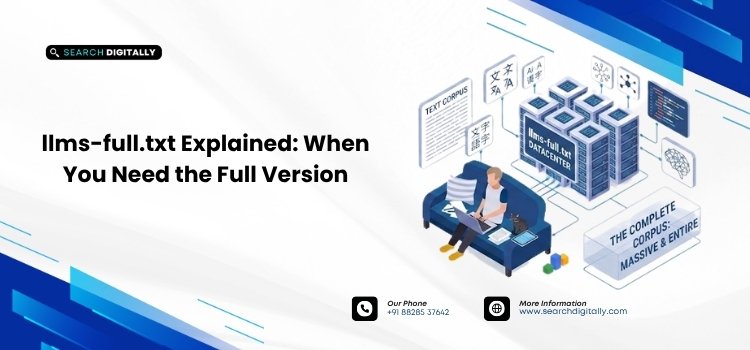
If you have spent any time reading up on how AI tools like ChatGPT, Claude, or Perplexity read websites, you have probably come across the term llms-full.txt. It sits alongside the now-familiar llms.txt file, but it serves a very different purpose. While llms.txt is meant to be a short, curated index pointing AI systems toward your most important pages, llms-full.txt is the extended version. It contains your actual content, sometimes the entire text of your site, dumped into a single plain-text file that AI crawlers can read in one pass without needing to visit dozens of individual URLs.
For a small business owner trying to figure out whether this is something worth setting up, the honest answer is: it depends on what your site looks like and how AI-driven traffic factors into your growth plans. This post breaks down what llms-full.txt actually does, how it compares to llms.txt, and when the full version genuinely earns its place on your server.
llms-full.txt vs llms.txt: Understanding the Two Versions
Once you start researching this topic, you will encounter two competing approaches, often labelled the full and small versions. Neither term is officially standardized as robots.txt is, but the community has settled on a rough convention that most implementations follow.
| Aspect | llms-full.txt | llms.txt |
| Content included | Complete text of pages, often the whole site | Condensed summaries or excerpts only |
| File size | Can run into hundreds of KB or several MB | Usually a few KB, quick to parse |
| Best suited for | Content-heavy sites, documentation, blogs | Smaller sites, landing pages, brochure sites |
| Crawl efficiency | Slower to process, but self-contained | Fast to process, but less detail |
The core difference comes down to depth versus speed. llms-full.txt trades a bit of crawl efficiency for completeness, which matters when an AI model needs granular detail from your pages rather than a surface-level summary. llms.txt trades detail for speed, which works fine when your site does not have much content depth to begin with.
When Do You Actually Need the Full Version of llms-full.txt?
Not all websites require an llms-full.txt file. Creating one is hard work, and if it’s not well organized or up to date, it can cause more confusion than clarity for AI crawlers. That said, there are a handful of situations where the full version genuinely makes sense.
- Your site contains wide-ranging blog archives, guides, and documentation that an AI tool might require numerous requests to access.
- You have a SaaS product or knowledge base where the answers are accurate and detailed, and require the AI models to grasp the technical nuances, not just the summary.
- Your business relies heavily on accurate citations in AI search results, and vague summaries risk misrepresenting what you offer.
You want the AI-generated answers to match your own words and claims, not to be a paraphrased index entry.
If any of these apply to you, the full version of llms-full.txt is well worth the installation. It provides AI systems with the “information” they need to process rather than having to guess at what it means from a shorter description.
When llms.txt Makes More Sense
On the other hand, many small-business websites lack sufficient depth of content to justify a full version. There’s no need to send a text dump of a five-page service site to a local plumber or a boutique consultancy. In these cases, a lean llms.txt file does the job just as well.
Maintaining an unnecessarily large llms-full.txt file for a thin site can actually work against you. It tells you that things are padded, not that they are anything, and if the AI crawlers are finding a few useful pages in a huge file, then it’s a bad use of anyone’s time.
How to Create and Structure Your llms-full.txt File
Setting up llms-full.txt is not particularly complicated from a technical standpoint, but getting the structure right matters more than getting it done quickly. The file should sit in your website’s root directory, use clean Markdown formatting, and group content in a logical order that mirrors how a reader would move through your site. If you have not built an llms.txt file before, our step-by-step tutorial on creating an llms.txt file walks through the basics, and the same principles apply when you scale up to the full version.
A few practical tips that tend to get overlooked:
- Strip out navigation menus, footers, and repeated boilerplate text that add no value for an AI reader
- Keep headings consistent with your actual page structure so the content maps cleanly back to your live URLs
- Update the file whenever you publish or significantly revise content, since a stale full version can mislead AI tools rather than help them
- Consider splitting extremely large sites into topic-based files rather than one unmanageable document
llms-full.txt and AI Search Visibility
A fair question to ask before investing time here is whether any of this actually moves the needle on visibility. The honest answer, based on what we covered in our piece on whether llms.txt improves SEO or AI citations, is that these files do not directly influence traditional search rankings. What they do influence is how accurately and efficiently AI systems can read and represent your content when they do decide to reference it.
Think of llms-full.txt less as a ranking lever and more as a clarity tool. It lessens the guesswork an AI crawler must do, an important factor as more people begin researching on AI chat platforms rather than classic search engines.
Common Mistakes to Avoid With llms-full.txt
A surprising number of businesses set up an llms-full.txt file once and then forget about it entirely. This creates the same kind of drift problem we see with other technical SEO assets. It is worth comparing this file with your other crawler-facing files, which we cover in our breakdown of llms.txt versus robots.txt versus sitemap.xml, since each serves a distinct purpose and none should be treated as a set-and-forget task.
Another common mistake is dumping raw HTML into the file instead of clean, readable text, which defeats the purpose of making content easy for AI models to parse. Structured elements like FAQ sections also translate well into these files; if your pages already use FAQ formatting, our guide on why FAQ schema matters for SEO and AI search explains how that same structured approach helps both traditional search and AI-driven answers.
Conclusion
llms-full.txt is not required for all websites, but for organizations with extensive documentation, content, or websites that heavily rely on accurate AI citations, it is a missing feature that the shorter version, llms.txt, cannot address. We examined the differences between llms.txt and llms-full.txt, when to use each, how to arrange llms-full.txt correctly, and what kinds of maintenance errors can be made that have a quiet effect on the usefulness of llms-full.txt. If your website contains a lot of content and you want your AI tools to reflect your business accurately, it makes sense to build out a well-maintained llms-full.txt file. If your site is small and straightforward, a lean llms.txt file will likely serve you just as well without the extra upkeep.
FAQs
Q1. Do I need both llms.txt and llms-full.txt on my website?
No, you don’t need both, but many sites opt to have both running together. The regular llms.txt file acts as a short index or table of contents, while llms-full.txt holds the complete content. For small business sites and sites with a modest number of pages, adding the full version can be sufficient; for larger content-heavy sites, add the full version to the llms.txt file.
Q2. How big can an llms-full.txt file get before it becomes a problem?
There is no official restriction on file size, but extremely large files may be slower for the AI crawler to process and may be truncated by certain tools. If your llms-full.txt file is in the megabyte range, you may want to remove old pages, eliminate duplicate sections, or break content into logical topic files rather than a single file.
Q3. Will using llms-full.txt guarantee my content shows up in AI answers?
AI-generated answers aren’t guaranteed in any one file; it just makes it easier for AI crawlers to access and understand your content accurately. Even though everything is right, the citation of your actual content will depend on the quality of your content and its relevance to the query, as well as the perceived authority of your site on the topic.
Figuring out whether your business needs the full version, the small version, or neither depends on your content volume, your goals around AI search visibility, and how your site is currently structured. If you would like a second opinion before you build anything, get in touch with our team at Search Digitally, and we will help you map out the right approach for your site.